Hit Me Again: The Weird Brain Science Behind Why the Second Laugh Always Lands Harder
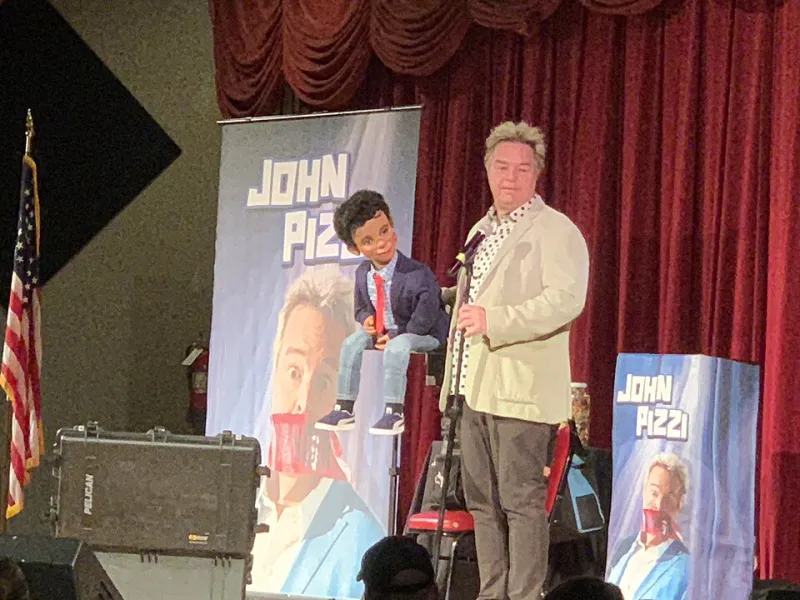
Photo: Jason Ingtonn, CC BY-SA 4.0, via Wikimedia Commons
Let's be honest. The first time someone says something funny, you might smile. Maybe you do a polite chuckle. You tip your metaphorical hat. But the second time — slightly tweaked, delivered with a knowing glance, dropped into a completely different context — you absolutely lose it. You're on the floor. You're sending it to your group chat with seventeen cry-laugh emojis.
This is not a coincidence. This is your brain doing something genuinely fascinating, and comedians, meme architects, and TikTok creators have been exploiting it for years. Here at Ricko Ricko, we believe everything worth doing is worth doing twice — and science, it turns out, agrees with us.
Your Brain Is Basically a Punchline Collector
Here's the deal: when you hear a joke for the first time, your brain is working overtime just trying to process it. You're parsing language, building context, chasing the logical thread, and then — bam — the punchline hits and your expectations get delightfully subverted. That surprise is what triggers the laugh.
But here's where it gets interesting. The second time around, your brain already has the map. It knows where the road goes. And instead of working to understand, it shifts into a different gear — anticipation. You're leaning in. You're waiting for that specific moment, and when it arrives, the reward feels even richer because you earned it. Psychologists call this "benign violation theory" layered with familiarity, and comedians just call it "the callback."
The callback is arguably the most reliable tool in any comic's toolkit. Set something up early, let the audience almost forget it, then drag it back at exactly the right moment with a twist. The crowd goes absolutely feral. Not because it's new — because it isn't.
SNL's Recurring Character Playbook
Saturday Night Live has built an entire cultural institution around this principle. Think about every time a beloved character walks back onto the stage. The audience doesn't wait for the joke — they are the joke, in the best possible way. The moment Stefon appears at the Weekend Update desk, or when the "More Cowbell" sketch gets referenced anywhere in pop culture, people light up before a single word is spoken.
That's the power of the second take operating at full capacity. SNL essentially trains its audience over weeks, seasons, and decades to be primed for specific comedic triggers. The setup becomes cultural shorthand. "I'm Jebediah Atkinson" doesn't need context anymore — it is the context. The laugh is baked in before the delivery even begins.
This is also why spin-off sketches, recurring bits, and "part two" installments consistently outperform their originals in terms of audience reception. The groundwork has already been laid. The comedian just gets to build on it.
TikTok and the Duet as Comedy Architecture
Nowhere is the "second take" dynamic more visible right now than on TikTok, where the duet feature has essentially turned repetition-with-a-twist into a native art form.
Someone posts a video. Someone else reacts, remixes, or rebuilds it. Then someone remixes that. By the time you're four duets deep into a chain, the original joke has mutated into something entirely new — but every iteration carries the DNA of what came before. The audience tracks the lineage. They feel the callback even when it's been stretched across a hundred different creators.
Meme culture operates on the exact same principle. A format gets established — say, the "distracted boyfriend" photo or the "woman yelling at a cat" split image — and then the humor compounds with every new variation. The first time you see the format, it's funny. By the forty-seventh variation, you're cackling at increasingly niche applications because your brain is getting a double hit: recognition and subversion, simultaneously.
That's the sweet spot. That's the Ricko Ricko zone.
The Setup-Punchline-Setup-Punchline Structure Is Running Your Feed
If you step back and look at what's actually dominating entertainment right now — from YouTube comedy channels to late-night monologues to podcast bits — a clear structural pattern emerges. It's not the single-shot joke. It's the loop.
Setup. Punchline. Brief pause. Same setup, new angle. Bigger punchline.
This structure works because it gives the audience two different pleasures in rapid succession: the surprise of the first hit, and the satisfaction of the second. It's the comedic equivalent of a double espresso. One shot wakes you up. Two shots make you believe in yourself.
Comedians like John Mulaney have mastered this at the macro level — entire hour-long specials are structured so that callbacks from the first twenty minutes explode in the final ten. Dave Chappelle does it. Bo Burnham's "Inside" does it in a way that borders on mathematical. The audience isn't just laughing at jokes; they're being rewarded for paying attention.
Why the Second Laugh Feels Personal
There's one more layer to this that doesn't get talked about enough: the second laugh feels earned. When a callback lands, part of the joy is the quiet internal celebration of having remembered the setup. You got it. You were there for both moments. You're in the club.
This is why inside jokes are so powerful, and why recurring bits on podcasts or YouTube series build such fiercely loyal audiences. It's not just that the content is funny — it's that understanding the joke signals membership in something. You're not just a viewer; you're a repeat customer, and the show is thanking you for showing up again.
Which, honestly, is the entire philosophy of this website in a nutshell. Twice the fun, double the Ricko — and now you know exactly why that hits different the second time you read it.
The Takeaway (Say It Again for the People in the Back)
The second take isn't a lazy rehash. It's a precision instrument. When comedians, creators, and meme lords deploy repetition with intention — with a twist, a new context, or a perfectly timed callback — they're not running out of ideas. They're using one of the most reliable neurological levers in the entire human experience.
Your brain wants to laugh twice. It wants the setup and the payoff, the original and the remix, the joke and the echo. Give it what it craves, and you've got comedy gold.
Now go back and re-read the first paragraph. Funnier now, right? Told you.